Buy Well
Test the property economics.
Evaluate rental-income assumptions alongside taxes, insurance, management, repairs, furnishings and reserves. Ask what happens if income falls short.
Investment-property financing
Buying or refinancing an Airbnb, Vrbo or traditional rental? See whether the numbers work. Our free tools connect property price, rental income, expenses and financing to estimated cash flow.
Research the property. Compare your financing. Move forward on your terms.
Free account required to view estimated rates. No obligation. No phone call required.
No personal tax returns or wage statements required for eligible programs.
Analyze. Compare. Prepare.
Research the income. Understand the cash flow. Compare financing choices. Keep the property and the questions that matter together in one workspace, then bring in our team when you want help.
Buy Well
Evaluate rental-income assumptions alongside taxes, insurance, management, repairs, furnishings and reserves. Ask what happens if income falls short.
Finance Well
Look at down payment, payment, points, prepayment terms and cash retained. A lower rate may require more cash upfront.
Prepare Well
Save the property check, identify the information that needs support and request a financing review when you are ready to proceed.
Inside the platform
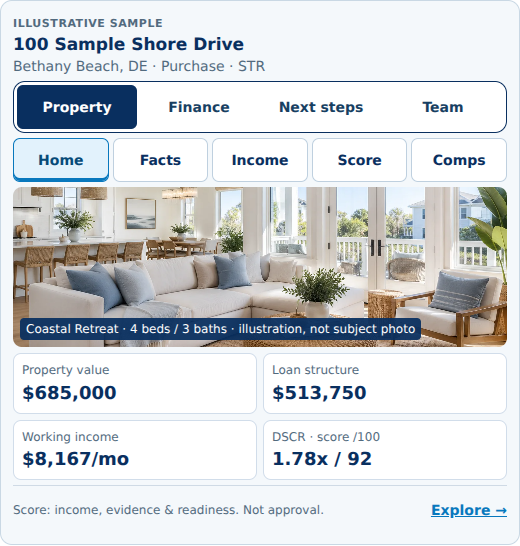
Review the factors behind the property’s opportunity score, including income coverage, market strength, financing fit, evidence and readiness. Use the breakdown to identify questions before making a decision.
The opportunity score explains the factors behind the result and highlights where stronger evidence may help. It is a decision aid, not a lender approval or a prediction of returns.
Get My RateBuy Well
Explore projected revenue, nightly rate, occupancy and available comparable-rental evidence together. Compare the assumptions with the property’s features and intended rental use. Market projections and documented operating history are different forms of evidence.
When a source does not return a value, keep that gap visible. Stronger income support may be needed before a lender can rely on the scenario.
Learn how short-term rental income supports financing reviewFinance Well
See how a different down payment changes cash required, estimated payment, debt coverage and cash flow. Compare the cash left for reserves, furnishings or the next purchase.
Operating expenses and available capital stay visible so the decision goes beyond the interest rate.
Explore financing tradeoffsHow rental-income financing works
Debt service coverage ratio compares qualifying rental income with the loan payment and the property expenses specified by the lender. That is what the initials DSCR mean.
For a traditional rental, a lender may use a lease or appraiser-supported rent. For a short-term rental, accepted projections or operating history depend on the program. A market estimate is not automatically qualifying income.
Coverage, property type, purchase or refinance purpose, credit, loan amount and down payment help determine program eligibility and estimated pricing. Debt coverage is one factor, not the whole decision.
A property can meet a lender’s coverage requirement while leaving little operating cash. Include management, maintenance, vacancy, utilities and reserves when evaluating the investment.
If a program accepts $4,000 in monthly qualifying rent and counts $3,200 in monthly housing expenses, the coverage ratio is 1.25: $4,000 divided by $3,200. Each lender defines its income basis, expenses and minimum coverage. This example does not establish approval or pricing.
Compare the structure
Compare available loan programs alongside estimated rates, payments, points and prepayment terms. Fixed-rate, adjustable-rate and interest-only structures can serve different plans; availability depends on the lender and your scenario.
Consider your holding period, cash reserves and plans to sell or refinance. Selecting a preliminary option saves a preference for review; it does not lock a rate or approve a loan. The sample below illustrates the comparison and is not current lender pricing.
Understand zero-point financingPrepare Well
The decision center keeps the property, income assumption and financing choice together. It includes reviewer invitations and a checklist of the information typically needed for an application.
Consider who should review the decision: an investing partner, a member of your limited liability company, your agent, tax professional or attorney. The sample shows collaboration around the same property; actual access and sharing require an authenticated workspace.
See how personal review worksSee the workflow
Follow one sample property through income, rating, financing and next steps. Use the workspace’s tabs to explore. The guide beside it explains the selected screen.
Start where you are
The property check asks about your purpose so the next questions fit the decision.
Start with the address, price, intended rental use and available cash. Consider the down payment alongside closing costs, setup and reserves.
Read the first-purchase guideStart with estimated value, current loan balance, rental performance and your goal. Compare a new payment or cash-out scenario with the cost of replacing the current loan.
Explore refinance and ownership considerationsThe rental plan matters
Projected market income, actual booking history and lease income are different inputs. Lenders decide which sources they accept for each program.
Review booking history or available market projections, seasonal income, management and local rental restrictions.
Explore short-term rental financingConsider furnished lease terms, utilities, vacancy between stays and the records supporting the income.
Explore mid-term rental financingReview current leases, available market rent, property expenses and lender appraisal requirements.
Explore long-term rental financingNo registration needed to view this example
This hypothetical purchase shows why lender qualification and operating cash flow need separate calculations.
$375,000 loan · $125,000 down payment · 30-year amortization
At an assumed 1.20 minimum rental-income coverage, this payment would need about $3,714 in qualifying monthly rent. A lender determines the permitted income source, adjustments and required coverage.
Assume $5,000 in monthly gross income and $1,800 in operating expenses, including the $600 for taxes, insurance and association dues. After $2,495 in principal and interest, cash flow is about $705/month, before income taxes and additional capital reserves.
The rental use must be permitted. Income and expenses need support. Insurance and management costs must fit the plan. At 20% lower gross income, with the same $1,800 expenses and debt payment, this example produces about negative $295/month.
Illustrative annual interest rate: 7.00%, fixed for the payment calculation. Loan: $375,000. Monthly principal and interest: $2,494.88. Taxes, insurance and association dues: $600/month. loan payment, taxes, insurance and association dues: $3,094.88. Required qualifying rent: $3,094.88 × 1.20 = $3,713.86. Assumed qualifying rent: $4,000/month. Gross operating income is separately assumed at $5,000/month. The $1,800 expense budget includes $600 for taxes, insurance and association dues, so cash flow subtracts principal and interest separately without counting those expenses twice. No lender, property data provider or actual listing supplied these assumptions. This calculation excludes closing costs, loan points, setup costs, additional capital reserves and income taxes. It is not an approval, rate lock, offer or commitment.
Keep the tradeoffs visible
Compare the cash required by each financing structure with the monthly payment and your expected holding period.
An eligible zero-point structure has no STR Advisory origination fee and no lender discount points. Other costs apply, including the disclosed $900 processing fee, $300 commitment fee and applicable lender and third-party charges.
Understand zero-point optionsPaying $5,000 in points for $100/month of payment savings creates a simple 50-month break-even. Review the expected holding period and prepayment terms before choosing. This example excludes other cost differences and the time value of money.
Compare financing structuresYour investor workspace
Create a free account to save your property research and view preliminary financing options. Keep the property facts, income assumptions and financing questions together as your decision develops.
Build a scenario around your purchase or refinance, intended rental use and available cash.
Review the source of the income estimate, expenses and unresolved questions before relying on the result.
Rates, rents and costs can change. Confirm current pricing and updated assumptions with our team before moving forward.
Tools first. Team review when ready.
STR Advisory combines a property-check workspace with a team that arranges eligible business-purpose financing through third-party lenders.
Step 1
Enter and verify the address, describe the purchase or refinance and provide the approximate numbers.
Step 2
Create an account to save the property and view preliminary options. Review the assumptions, compare saved opportunities and identify information that still needs verification.
Step 3
Choose a preliminary option and request a review when you are ready. We help confirm the program fit, prepare your package, submit it to the selected lender and coordinate the process toward closing. The lender determines final terms and approval.
A preliminary check is not a loan application, approval, rate lock or commitment. Program matches and estimates remain subject to verification and lender underwriting.
See the property tools and personal-review processYour professional team stays involved
Your agent can help with the property and offer. Your tax professional can review tax treatment. Your attorney can address ownership and contracts. Your advisor can evaluate liquidity and portfolio fit.
STR Advisory organizes the property and financing scenario, reviews eligible lender choices and coordinates the transaction.
Explore professional collaborationAfter the transaction
Property Depreciation Pro is a separate service for organizing property documentation for professional review. Explore it when you are ready to document the property, furnishings and improvements.
Explore Property Depreciation ProProperty documentation does not determine financing eligibility or replace tax, legal, accounting or specialist advice.
No credit pull is part of the preliminary property check. A formal financing application may require credit authorization and additional borrower information.
You can view the sample calculation on this page without registering. The current property-check workflow asks you to create an account to save your own property and view preliminary options.
Not necessarily. The lender decides which income records or projections it accepts and whether adjustments apply. Operating cash flow also includes expenses that may be treated differently in a lender’s rental-income coverage calculation.
No. Approval, final pricing and program availability depend on lender underwriting, property and borrower eligibility, applicable state requirements and documentation.
Create your free account to explore estimated rates and save your property research. Ask our team for help when you are ready to move forward.
Estimates depend on the information provided and available data. STR Advisory arranges loans through third-party lenders and does not fund loans or make credit decisions. Financing is subject to lender underwriting, property eligibility and applicable state requirements. We do not guarantee income, cash flow, financing or tax outcomes.


